

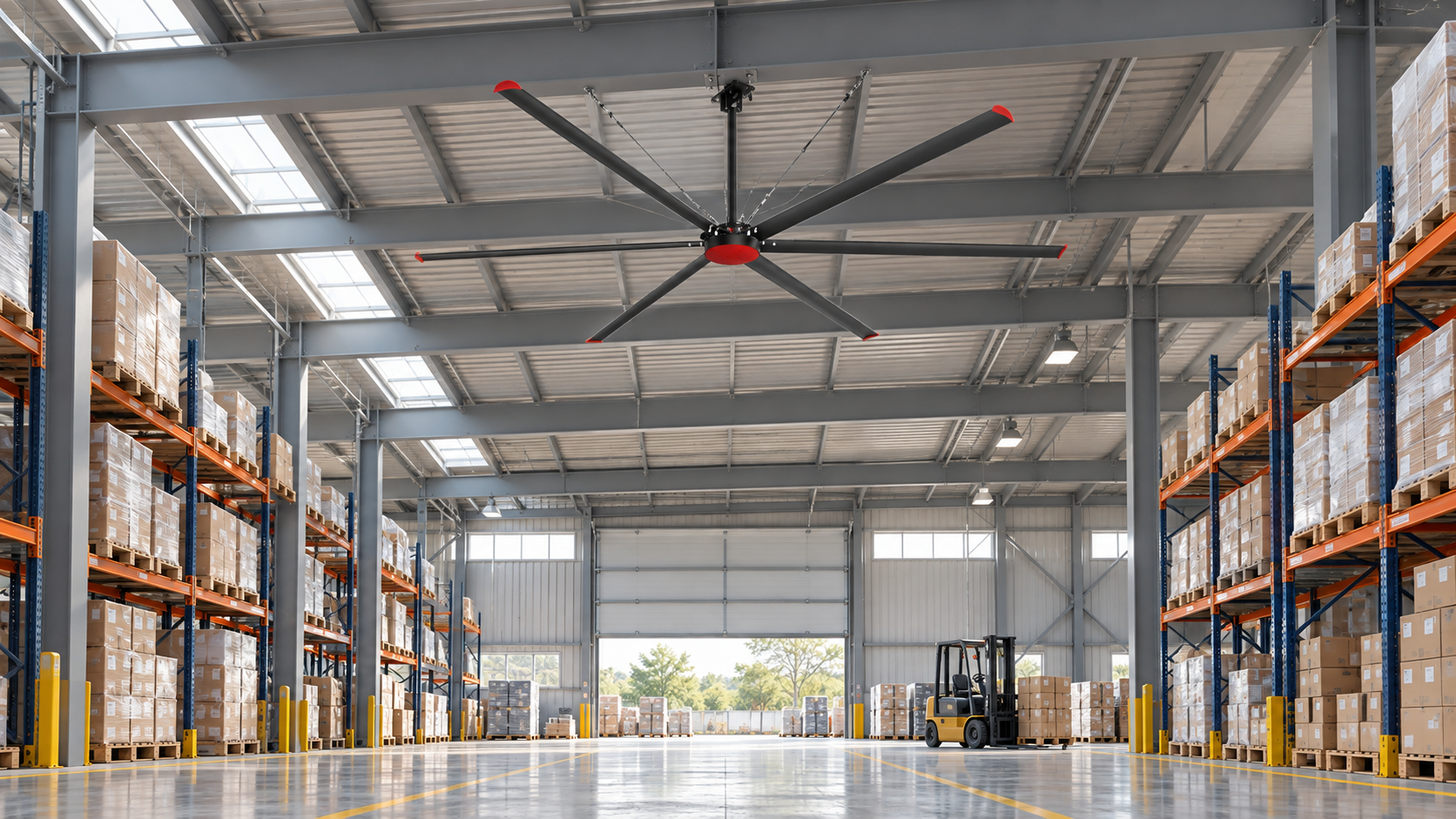
When evaluating ventilation system upgrades for large spaces, facility managers often focus heavily on Return on Investment (ROI). Although installing HVLS (High-Volume, Low-Speed) fans represents a capital expenditure, many industrial business owners overlook the fact that their value extends far beyond simple electricity savings.
A comprehensive HVLS ROI analysis should cover multiple aspects, including direct energy savings, reduced maintenance costs, improved employee productivity, and minimized product spoilage. Many projects pay for themselves within **1 to 3 years**, while the equipment boasts a lifespan of 15 to 20 years—meaning net gains are realized for many years thereafter. However, not all HVLS solutions yield the same returns; actual airflow performance directly determines the length of the payback period.
Sources of HVLS ROI
Returns from HVLS fans generally fall into two categories: directly quantifiable cost savings and indirect operational benefits.
Direct Cost Savings
1. Reduced HVAC Energy Consumption**
When used in conjunction with air conditioning systems, HVLS fans allow you to raise thermostat setpoints while maintaining employee comfort. Cooling energy consumption in most facilities can be reduced by 20% to 30%. In winter, the fans' air-mixing action eliminates thermal stratification by pushing warm air—which naturally accumulates near the ceiling—downward, thereby reducing the heating load in high-ceilinged facilities. Since HVLS fans themselves consume very little power, the overall net energy savings are significant.
2. Reduced Need for Small Fans and Blowers
A single HVLS fan can replace dozens of small wall-mounted fans. Fewer units mean less need for replacement parts and repairs; total power consumption is also lower compared to running multiple small, high-speed fans.
3. Lower HVAC Maintenance Costs
Because HVAC equipment operates less frequently and avoids constant full-load operation, component wear and tear is reduced. This not only extends the service life of HVAC equipment but also reduces annual maintenance costs.
Indirect Operational Benefits
While these benefits may not appear directly on a balance sheet, they can significantly improve a company's bottom line.
- Increased employee productivity and reduced turnover**: High heat stress can slow down work and lead to high staff turnover. Consistent airflow alleviates fatigue caused by stuffy, stagnant air. A more comfortable workspace helps retain skilled workers and ensures consistent production output.
- Reduced product and material spoilage**: Continuous air circulation helps control humidity and prevent condensation. It protects raw materials, finished goods, and livestock from moisture damage, thereby reducing waste and scrap rates.
- Enhanced workplace safety: Keeping floors dry reduces the risk of slips and falls in factories and warehouses.
Typical Payback Periods for HVLS Fan Installations
Payback periods vary based on building size, local energy prices, existing HVAC configurations, and fan airflow performance.
- Large facilities with existing HVAC systems: **12–24 months**
- Medium-sized workshops and warehouses: **18–30 months**
- Large, non-air-conditioned spaces: **2–3 years** (driven primarily by productivity gains and humidity control benefits)
>
> Simple payback period formula:
> **Payback Period = Total Installation Cost ÷ Annual Net Savings**
> Annual Net Savings = Total Annual Benefits - Fan Operating and Maintenance Costs
Why Low-Cost HVLS Fans Can Harm Return on Investment (ROI)
This is a critical point that many buyers overlook.
There is a wide price range for HVLS fans on the market, and airflow performance varies significantly. High-performance models can deliver **several times** the airflow of low-cost alternatives. While low-priced fans may look similar, the actual volume of air they deliver is often much lower. Insufficient airflow leads to tangible negative consequences:
- Limited effective coverage area
- Poor air mixing and limited ability to eliminate thermal stratification
- Negligible reduction in HVAC runtime
- Ineffective cooling for personnel
While upfront purchase costs may be lower, fans with weak airflow yield significantly smaller annual savings. This results in a longer payback period and a lower overall return on investment (ROI). When comparing quotes, be sure to evaluate verified airflow delivery and actual coverage area; do not base your decision solely on price.
How to Maximize ROI for HVLS Systems
1. Precisely match fan diameter and quantity to ceiling height and floor layout. Oversizing wastes capital, while undersizing severely compromises performance.
2. Select high-efficiency permanent magnet brushless motors to reduce fan operating power consumption.
3. Implement group speed controls to operate fans only when needed, thereby minimizing energy waste from idle running.
4. For hot and humid facilities, combine HVLS fans with industrial air conditioning or dehumidifiers to maximize energy-saving potential.
5. Factor indirect benefits—such as increased productivity and reduced material spoilage—into your internal business case.
Conclusion
HVLS (High-Volume, Low-Speed) fans deliver significant ROI by lowering energy costs, reducing maintenance requirements, and improving operational efficiency. Most projects achieve payback within 1 to 3 years and continue to generate energy savings for over a decade.
True ROI depends not on the fan's list price, but on its actual airflow performance—which directly determines how much energy you save and how quickly you recoup your investment. Facility managers planning to upgrade their ventilation systems should prioritize proven airflow performance rather than focusing solely on low hardware costs.
Navigation
Send Us A Message
Please give us a message
Suzhou First Machinery Technology Co., Ltd