

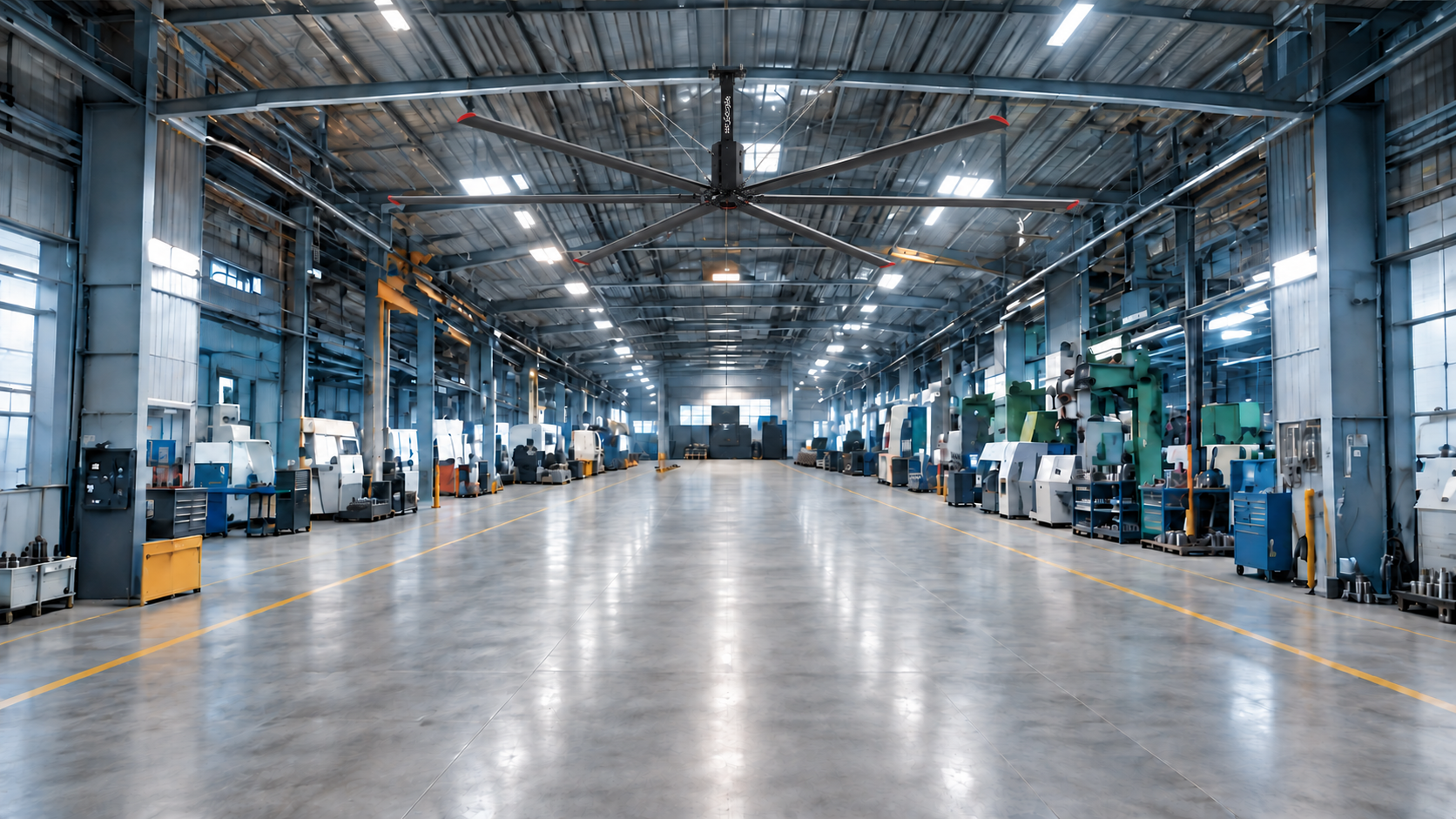
If you manage facilities with high ceilings—such as manufacturing plants, warehouses, or livestock barns—you may have asked yourself: **Is it worth investing in HVLS (High-Volume, Low-Speed) fans?**
HVLS fans require an upfront investment for purchase and installation. Decision-makers often hesitate due to initial costs, comparing them unfavorably to cheap, small fans or simply deferring ventilation upgrades. However, the value of HVLS fans extends far beyond the sticker price. Their true worth lies in long-term energy savings, improved operational efficiency, and a lifespan spanning many years. For most large, high-ceilinged spaces, HVLS fans deliver a significant return on investment.
The Value of HVLS Fans
1. Lowering Cooling Energy Costs
While HVLS fans do not generate cold air themselves, they regulate the environment through the wind-chill effect (perceived cooling) and by eliminating air stratification. When used alongside existing air conditioning systems, they allow you to raise the thermostat setting while maintaining employee comfort. Consequently, most facilities can reduce cooling energy consumption by **20%–30%**.
In high-ceilinged buildings, HVLS fans also mix warm air that accumulates near the ceiling during winter, thereby reducing the heating load. Since HVLS fans consume very little electricity themselves, the overall energy savings are substantial. A single large HVLS fan can replace dozens of small wall-mounted fans, further cutting power consumption.
2. Reducing Maintenance Needs and Extending HVAC System Lifespan
By shouldering part of the cooling load, HVLS fans allow air conditioning systems to operate less frequently, avoiding continuous full-capacity running. Reduced operating time slows component wear and lowers the frequency of repairs, ultimately extending the lifespan of the HVAC (Heating, Ventilation, and Air Conditioning) system. Furthermore, having fewer small fans on-site means fewer potential points of failure and lower replacement costs.
3. Boosting Employee Performance and Retention
Heat stress and poor air circulation can impair employee concentration and productivity. The airflow generated by HVLS fans can lower the perceived temperature by 4–6°C, thereby alleviating heat-related fatigue and reducing workplace risks associated with high temperatures. A comfortable working environment not only boosts productivity but also helps lower employee turnover—an often-underestimated economic benefit for manufacturing facilities.
4. Protecting Inventory and Enhancing Site Safety
Continuous air circulation helps control humidity and condensation. It keeps concrete floors dry, reducing the risk of slips and falls caused by wet surfaces. For warehouses, garment factories, and livestock facilities, steady airflow prevents moisture buildup, thereby minimizing spoilage and damage to raw materials and finished goods.
Typical Payback Period
The payback period depends on the size of the facility, local electricity rates, existing cooling systems, and the fan's airflow performance.
- Facilities with existing air conditioning: **12–24 months**
- Medium-sized workshops and warehouses: **18–30 months**
- Large, non-air-conditioned spaces: **2–3 years** (returns driven primarily by productivity gains and humidity control)
High-quality HVLS (High-Volume, Low-Speed) fans have a lifespan of 15–20 years. Once the initial investment is recouped, the savings on energy and maintenance translate into pure profit for over a decade.
Key Pitfall: Low-Priced Fans May Not Be Worth the Investment
HVLS fans on the market vary significantly in price and airflow performance. High-performance models can deliver several times the airflow volume of cheaper alternatives.
Low-cost HVLS fans may look identical to premium models but often lack effective air delivery capabilities. Insufficient airflow results in limited coverage, poor air mixing, and negligible cooling effects. Despite the lower upfront cost, these units yield minimal annual savings, thereby extending the payback period and severely impacting the Return on Investment (ROI). When evaluating suppliers, do not select an HVLS fan based solely on price. Always verify the actual airflow output and effective coverage area. Poor airflow performance is the primary reason HVLS projects fail to meet expectations.
Ideal Applications for HVLS Fans
Investing in HVLS fans is highly cost-effective for facilities such as:
- Workshops, warehouses, or distribution centers with high ceilings
- Work areas prone to heat stratification or stuffiness
- Facilities with high air conditioning costs
- Humid environments at risk of condensation or moisture damage
- Livestock facilities requiring continuous air circulation
Conclusion
So, are HVLS fans worth the investment?
For most large industrial and commercial facilities with high ceilings, **the answer is yes**. HVLS fans deliver significant energy savings, reduced maintenance requirements, a more comfortable work environment, and less product spoilage. Most installations pay for themselves within 1–3 years and continue to generate benefits for over 15 years. The key is simple: the return on investment depends on actual airflow performance. Choosing a low-cost fan with poor airflow not only undermines expected benefits but also diminishes the investment's appeal. Therefore, before making a decision, be sure to compare airflow performance data rather than just price quotes.
Navigation
Send Us A Message
Please give us a message
Suzhou First Machinery Technology Co., Ltd